The UAE is replacing PDF and paper invoices with structured, machine-readable e-invoices that are exchanged through government-accredited providers and reported to the Federal Tax Authority (FTA). For businesses with annual revenue of AED 50 million or more, the first hard deadline is days away: they must appoint an Accredited Service Provider (ASP) by 30 October 2026, and mandatory e-invoicing starts on 1 January 2027. Other in-scope businesses follow on 1 July 2027.
If your invoices come out of an ERP in the UAE, this is not just a finance project. Customer tax details, credit note logic, invoice numbering and archiving all live in your system, and weak data there will surface as rejected invoices later. This guide sets out the dates, scope, penalties and ongoing obligations from the primary Ministry of Finance (MoF) documents, explains what changed in October 2026, and gives a practical plan.
- Revenue AED 50M or more: appoint an ASP by 30 Oct 2026; mandatory from 1 Jan 2027.
- Revenue below AED 50M: appoint an ASP by 31 Mar 2027; mandatory from 1 Jul 2027.
- Government entities: appoint an ASP by 31 Mar 2027; mandatory from 1 Oct 2027.
- Penalty for failing to implement or appoint an ASP on time: AED 5,000 per month or part of a month.
The UAE e-invoicing timeline at a glance
| Date | Milestone | Applies to |
|---|---|---|
| 1 Jul 2026 | Pilot programme starts; voluntary adoption allowed | Selected pilot participants; anyone volunteering |
| 1 Oct 2026 | New ASP accreditation framework (Ministerial Decision 168 of 2026) takes effect | Service providers |
| 30 Oct 2026 | Deadline to appoint an ASP | Revenue AED 50M or more |
| 1 Jan 2027 | E-invoicing mandatory | Revenue AED 50M or more |
| 31 Mar 2027 | Deadline to appoint an ASP | Revenue below AED 50M; government entities |
| 1 Jul 2027 | E-invoicing mandatory | Revenue below AED 50M |
| 1 Oct 2027 | E-invoicing mandatory | Government entities |
These dates have already moved once. Ministerial Decision No. 66 of 2026 pushed the first-wave ASP appointment deadline from 31 July to 30 October 2026, but left the 1 January 2027 go-live untouched. The extension gave businesses more time to choose a provider, not more time to be live. Plan on the dates as written and re-check the MoF eInvoicing portal before you act.
Who must comply, and who does not
The AED 50 million revenue test
The phases are set by “Revenue”, which Ministerial Decision 244 of 2025 defines as gross income in the most recent accounting period, taken from financial statements prepared under UAE law (or other documents the FTA accepts). The decision is framed around each “Person”, so if you operate several legal entities, assess each one and confirm the position with your tax adviser.
What is in scope
Ministerial Decision 243 of 2025 applies to any person conducting business in the UAE, for every business transaction that is not specifically excluded. Obligations run both ways. Issuers must issue and transmit e-invoices and e-credit notes; recipients must process them through the same system. A business that issues few invoices but buys heavily still has an accounts payable workload to prepare.
What is excluded
The decision lists several exclusions, including:
- Business-to-consumer (B2C) transactions. A person engaged exclusively in B2C sales is not subject to the system until the Minister decides otherwise.
- Government entity transactions carried out in a sovereign capacity that do not compete with the private sector.
- Certain airline transactions (international passenger tickets and related documents; air cargo airway bills for a limited 24-month period).
- Financial services that are VAT-exempt or zero-rated under Article 42 of the VAT Executive Regulation.
Anyone can also adopt e-invoicing voluntarily from 1 July 2026. The penalty rules do not apply to voluntary users.
What actually counts as an e-invoice
MoF is explicit that PDFs, Word documents, images, scans and emails are not e-invoices. An e-invoice is structured invoice data, issued and exchanged electronically and reported to the FTA. Sending a PDF by email will not satisfy the mandate once it applies to you.
How the five-corner model works
The UAE uses a decentralised model built on the Peppol framework and a UAE specification called PINT AE. Five parties are involved:
- Corner 1: the supplier submits invoice data to its ASP.
- Corner 2: the supplier’s ASP validates the data, converts it into the UAE standard XML format if needed, sends it to the buyer’s ASP and reports tax data to the FTA.
- Corner 3: the buyer’s ASP validates the invoice, delivers it to the buyer and also reports tax data to the FTA.
- Corner 4: the buyer receives the invoice.
- Corner 5: the FTA receives the tax data and sends status messages back.
Validation outcomes flow back as status messages. If validation fails, the invoice is not reported onward and a negative status goes back to the sender. The practical consequence is that your ERP no longer “just issues” an invoice. It produces data that must pass validation at the ASP, and someone must handle the exceptions.
What changed in October 2026
On 9 October 2026, MoF announced Ministerial Decision No. 168 of 2026, which sets a new accreditation framework for service providers. It repeals Decision 64 of 2025 and its amendments and removes the earlier pre-approval stage: providers now complete defined assessment and testing before accreditation is granted. Providers that held preliminary approval were given up to 30 days from 1 October 2026 to meet the new requirements, according to Economy Middle East’s report.
Three practical points follow:
- Check the register, not the brochure. MoF publishes the official list of Accredited Service Providers. When this article was prepared (14 October 2026) it listed 65 accredited providers, plus five pre-approved providers still in final assessment. In May 2026 MoF had reported 32 approved providers, so the market is expanding quickly.
- Do not rely on “pre-approved” status alone. Full accreditation is the status that matters.
- Write contingencies into your contract. Ask what happens to your service if the provider’s accreditation lapses or is terminated, and how migration to another ASP would work.
Penalties for non-compliance
Cabinet Decision No. 106 of 2025 sets administrative penalties for mandatory users:
| Violation | Penalty |
|---|---|
| Failing to implement the system, including failing to appoint an ASP by the deadline | AED 5,000 for each month or part of a month of delay |
| Failing to issue and transmit an e-invoice on time | AED 100 per invoice, up to AED 5,000 per calendar month |
| Failing to issue and transmit an e-credit note on time | AED 100 per credit note, up to AED 5,000 per calendar month |
| Issuer fails to notify the FTA of a system failure on time | AED 1,000 per day or part of a day |
| Recipient fails to notify the FTA of a system failure on time | AED 1,000 per day or part of a day |
| Failing to notify the ASP of changes to data registered with the FTA on time | AED 1,000 per day or part of a day |
Illustrative arithmetic (hypothetical): if a business issues 80 invoices late in one month, the per-invoice rule gives AED 8,000, but the monthly cap limits it to AED 5,000. The AED 5,000 monthly penalty for not implementing at all, however, keeps running for every month or part of a month of delay.
The fines are modest next to the operational cost of invoices that cannot be issued or received. The bigger exposure is disrupted billing and delayed collections.
Obligations that continue after go-live
Meeting the deadline is the start. Under Decision 243, in-scope businesses must also:
- Issue on time. E-invoices and e-credit notes must be issued and transmitted through the system within 14 days of the date of the business transaction. VAT registrants must also meet the VAT Law’s invoicing timelines.
- Issue credit notes in the right cases. The decision lists four triggers: a cancelled transaction, a reduced consideration, a full or partial refund, and an administrative or numerical error.
- Report through the ASP. Issuers and recipients must report e-invoices and credit notes to the FTA within the timeline set by the Minister, fulfilling this through their appointed ASP.
- Store data in the UAE. E-invoices, credit notes and associated data must be stored within the country for the period required by the Tax Procedures Law.
- Report outages. Notify the FTA of a system failure within two business days.
- Keep registered data current. Tell your ASP in writing about changes to data registered with the FTA within five business days of the FTA confirming the change.
The decision also allows agents to issue on behalf of principals, and recipients to self-bill for transactions where both parties are VAT registrants, subject to conditions.
What to do now: a practical plan
If your revenue is AED 50 million or more
The appointment deadline is within two weeks of this article’s publication, and go-live follows about nine weeks after it.
- Confirm scope this week. Check revenue by legal entity against the AED 50M test and note any exclusions.
- Shortlist from the MoF register. Use MoF’s own considerations for selecting an ASP: company history, integration with your ERP, where data is stored, security certifications, support SLAs and pricing model.
- Sign and appoint before 30 October. Confirm the integration method (API, file exchange or connector), data residency, exit terms and what is included in the price.
- Start integration and testing immediately. Do not wait for go-live week. The pilot and voluntary adoption have been open since 1 July 2026.
- Clean master data in parallel (see below).
- Train accounts receivable and payable teams on exception handling, rejected invoices and credit note rules.
If your revenue is below AED 50 million
Your ASP appointment deadline is 31 March 2027 and go-live is 1 July 2027. Use the window to clean your data, map your invoicing process, budget for the change and talk to your ERP vendor early. Providers that are queuing now will be busy later, and the early adopters’ experience is free learning.
Where your ERP fits: getting invoice data e-invoice-ready
The following are practical recommendations, not additional legal requirements, except where cited above.
- Customer and supplier tax identifiers. MoF’s glossary defines the Tax Identification Number (TIN) as the first 10 digits of the 15-digit Tax Registration Number (TRN). Make sure every counterparty record holds a valid, correctly formatted TRN.
- Tax treatment. Consistent VAT categories on items and services, including zero-rated and exempt supplies, make validation far smoother.
- Credit note process. Replace manual overwrites with separate, reasoned credit notes mapped to the four legal triggers.
- Invoice numbering and timing controls. Build in alerts for invoices approaching the 14-day issue limit.
- Procurement side. Plan how structured supplier invoices will be received, matched to purchase orders and approved.
- Multi-branch and multi-entity mapping. Each legal entity needs the right registration data and ASP connection.
- Exception handling and archiving. Decide who fixes a rejected invoice, how fast, and where the UAE-resident archive sits.
Illustrative example (hypothetical, not a FACTS ERP client): a Dubai distributor with AED 62 million in revenue fixes billing mistakes by editing issued invoices, and a share of its customer records have missing or mistyped TRNs. Once e-invoicing applies, corrections must be separate structured credit notes, and invoices whose data fails validation can be rejected. The company’s first job is not picking technology. It is repairing master data and the credit note process.
How FACTS ERP can help
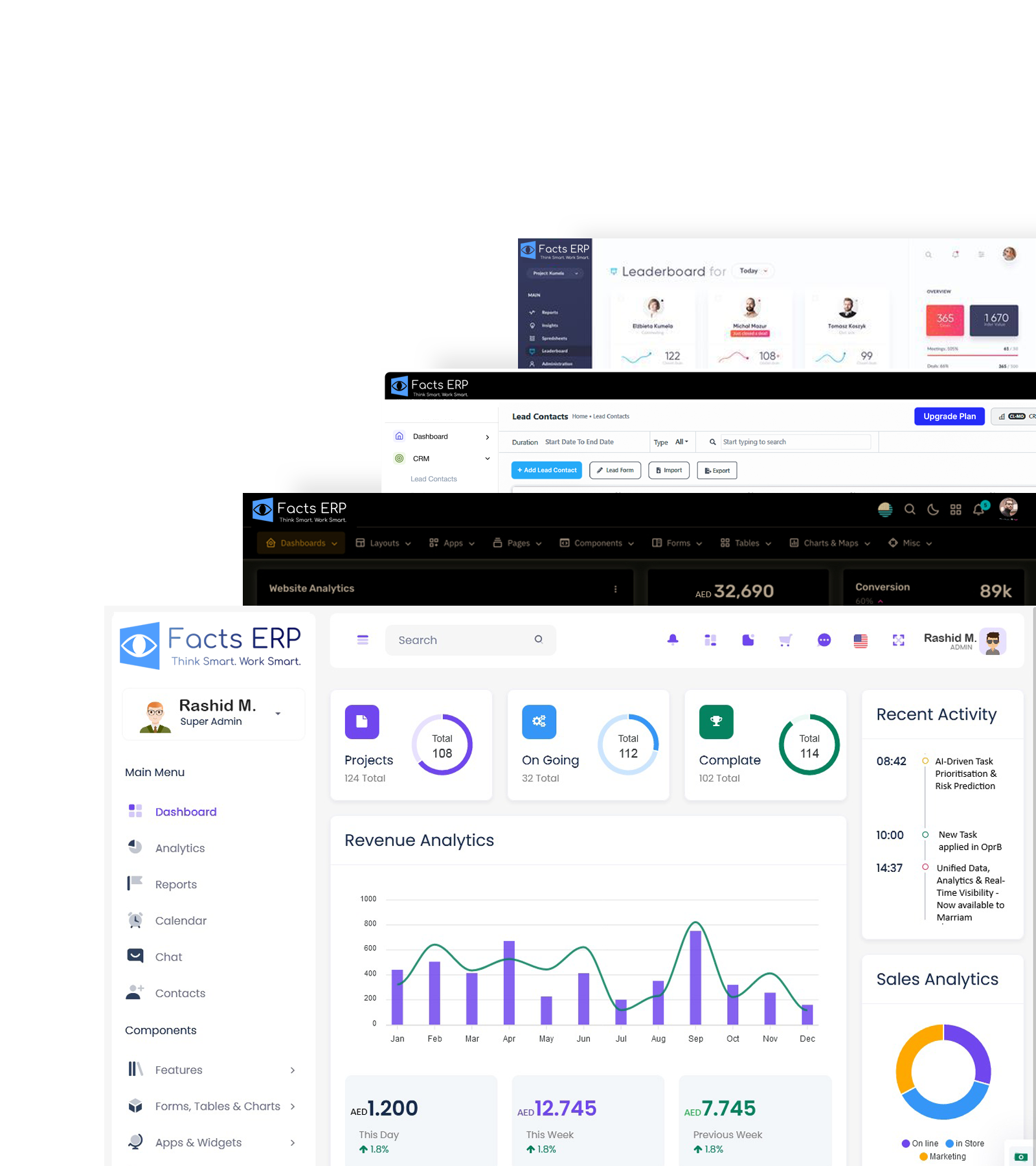
FACTS ERP’s e-invoicing page describes generation of tax invoices, simplified tax invoices, credit notes and debit notes aligned to UAE VAT rules, automated VAT calculation, a digital invoice store with audit trail, VAT reporting, and API and system integrations with ERP, POS, accounting and CRM platforms. The related VAT accounting software page covers VAT return and reporting. Those are the building blocks on the issuer side of the new process.
The mandate adds something different: structured PINT AE data, exchanged through an ASP that appears on MoF’s register. Choosing an ASP is a separate decision from choosing your ERP, so the useful conversation to have with FACTS ERP is practical. Ask how your current invoicing setup maps to the MoF data requirements, which ASP connection options are supported for your deployment, and what data clean-up your records need first. FACTS ERP’s team can also advise on customised ERP development where your workflows need adjusting.
Frequently asked questions
When does e-invoicing become mandatory in the UAE?
It starts on 1 January 2027 for businesses with revenue of AED 50 million or more, on 1 July 2027 for other in-scope businesses, and on 1 October 2027 for government entities.
Is 30 October 2026 the go-live date?
No. It is the deadline for businesses with AED 50M+ revenue to appoint an Accredited Service Provider. Mandatory e-invoicing starts on 1 January 2027.
Can I still email PDF invoices after the mandate starts?
Not for transactions that fall under the mandate. MoF states that PDFs, Word files, images, scans and emails are not e-invoices. B2C transactions are currently outside the system, and businesses in later phases have until their own start dates.
Can I connect directly to the FTA?
No. Decision 243 requires issuers and recipients to meet their exchange and reporting obligations by appointing an Accredited Service Provider.
How do I check whether a provider is accredited?
Use MoF’s published register of Accredited Service Providers, which lists each provider’s accreditation number. Pre-approved providers that are still in final assessment appear in a separate table.
What are the penalties for missing the deadline?
Failing to implement the system, including failing to appoint an ASP on time, carries AED 5,000 for each month or part of a month of delay. Other penalties cover late invoices, late credit notes and unreported system failures (see the table above).
Will my current ERP need to change?
That depends on whether it can produce the structured data MoF requires and connect to your chosen ASP. Ask your ERP vendor and your ASP to confirm both, and test with real invoices before go-live.
Conclusion
The UAE e-invoicing mandate is a system change, not just a format change. For AED 50M+ businesses the sequence is fixed: appoint an accredited provider by 30 October 2026 and be live on 1 January 2027. For everyone else, 2027 is a preparation window worth using. The businesses that cope best will be those that treat it as a data and process project: clean tax identifiers, disciplined credit notes, tested integration and a clear owner for exceptions.
Not sure how your invoicing and VAT processes map to the new requirements?
Talk to the FACTS ERP team or explore the FACTS ERP e-invoicing solution. Regulatory details can change, so confirm dates on the MoF portal before acting.
This article is general information, not legal or tax advice.
Explore FACTS ERP
Tatmeen UAE compliance software / Textile ERP Software / Trading & Distribution / VAT Accounting Software / Warehouse ERP Software