If your business has annual revenue below AED 50 million, UAE e-invoicing is still some way off: you must appoint an Accredited Service Provider (ASP) by 31 March 2027 and be live by 1 July 2027. That sounds like plenty of time. It is not, once you count what has to happen first: sorting out your tax identifiers, cleaning customer and item data, finding a provider and testing real invoices.
This guide gives SME owners, finance managers and accountants a six-stage readiness checklist, a suggested month-by-month timetable and the questions to ask your software vendor. If your invoices come from an ERP in the UAE or from accounting software, the checklist shows what to prepare in each system. You can also download it as a printable PDF with owner and due-date columns. For the full rules, see our UAE e-invoicing mandate guide.
- Appoint an ASP by 31 March 2027 and go live on 1 July 2027 if your revenue is below AED 50 million.
- E-invoicing is not limited to VAT-registered businesses. MoF states that it applies to any person conducting business in the UAE unless specifically excluded.
- Your Tax Identification Number (TIN) is the first 10 digits of the TRN the FTA issued to you. If you are in scope but not registered with the FTA for any tax type, you must generate a TIN through EmaraTax.
- Businesses that sell only to consumers (B2C) are not currently subject to the system.
Why SMEs should not wait until 2027
From early November 2026 you have about five months until the appointment deadline and just under eight until go-live. Three reasons to start now:
- The first wave is a free preview. Businesses with AED 50 million or more in revenue are choosing providers and testing integrations right now. You can learn from their experience and from a market that is expanding quickly: MoF’s register listed 65 accredited providers on 14 October 2026, up from 32 approved in May.
- Data clean-up takes longer than expected. Missing customer tax numbers, free-text units and inconsistent VAT codes cannot be fixed in a weekend.
- Voluntary adoption is open. Since 1 July 2026 you can start early, and the penalty rules do not apply to businesses using the system voluntarily.
Quick scope check for smaller businesses
- Revenue test. MoF defines revenue as gross income in the most recent accounting period, taken from financial statements. Assess each legal entity separately and confirm with your tax adviser if you run several.
- Not VAT-registered? You are still in scope unless excluded. Without a TRN you would issue a commercial invoice rather than a tax invoice. MoF’s field list sets 49 mandatory fields for a commercial invoice and 51 for a tax invoice.
- Free zone companies. Baker McKenzie’s summary of MoF’s Guidelines notes that free zone transactions are fully in scope. The e-invoice carries a flag for free trade zone supplies.
- Mixed customers. If you sell to both businesses and consumers, your B2B invoices are in scope even though pure B2C sales are not.
A suggested timetable from now to 1 July 2027
Only the two dates in bold are regulatory. The rest is our recommended pacing, based on working backwards from the deadlines.
| When | What to do |
|---|---|
| Nov 2026 | Confirm scope and dates. Secure your TIN and registration details. Name a project owner. |
| Dec 2026 | Map every invoicing system and document type. Start the data audit. |
| Jan – Feb 2027 | Finish data clean-up. Shortlist providers from MoF’s register and collect itemised quotes. |
| End of Feb 2027 | Target date to sign with your ASP, leaving a month of buffer. |
| 31 Mar 2027 | Regulatory deadline to appoint an ASP. |
| Apr – May 2027 | Integration and end-to-end testing with real invoices and credit notes. |
| June 2027 | Train teams, write outage and rejection procedures, run dry runs. |
| 1 Jul 2027 | E-invoicing mandatory. Plan extra support for go-live week. |
The six-stage SME readiness checklist
Work through the stages in order, and assign an owner and a date to every task. Each task is based on the MoF decisions and guidance linked in the sources below.
Stage 1: Confirm your scope and dates (Weeks 1-2 (Nov 2026))
- Check last accounting-period revenue for each legal entity. Below AED 50 million puts you in the second phase.
- Write down your two dates: appoint an Accredited Service Provider (ASP) by 31 March 2027; e-invoicing mandatory from 1 July 2027.
- Check for exclusions: businesses that sell only to consumers (B2C), certain government, airline and exempt financial-services transactions.
- Note special cases: free zone supplies, exports, and VAT group members (MoF’s Guidelines give intra-group transactions a 24-month grace period from 1 January 2027).
- Name one project owner and one management sponsor.
Stage 2: Get your identifiers in order (Weeks 1-4 (Nov 2026))
- Find your Tax Identification Number (TIN): the first 10 digits of the TRN the FTA issued to you for any tax type.
- In scope but not registered with the FTA for any tax type? Generate your TIN through EmaraTax.
- Confirm your TRN, trade licence number, licence authority and legal registration type (TL, EID, PAS or CD).
- Check that the name and address registered with the FTA match your invoices.
- Tax Group member? Use your own TIN, not the Tax Group representative’s.
Stage 3: Map how you invoice today (Dec 2026)
- List every system or file that produces invoices: ERP, accounting software, POS, spreadsheets, customer portals.
- Count monthly invoices and credit notes for each entity. You will need these numbers to price an ASP.
- List the document types you issue: tax invoices, commercial invoices, credit notes, self-billed and agent invoices.
- Flag special transactions: free zone, deemed supply, exports, continuous supply, margin scheme, summary invoices, e-commerce, disclosed agent billing.
- Document how you correct invoices today. Overwriting is out; corrections must be credit notes with a reason.
- Map the receiving side: how supplier invoices arrive, who approves them, how they are matched to orders.
Stage 4: Clean your data (Dec 2026 – Feb 2027)
- Customers: full legal name, TRN or TIN, trade licence details, address and country.
- Remove duplicate and inactive customer and supplier records.
- Items and services: clear name, description and unit of measure on every record.
- Tax set-up: a consistent VAT category and rate on every item, including zero-rated, exempt and reverse-charge cases.
- Payment terms and due dates present on every invoice.
- Foreign-currency invoices: confirm your system can state VAT in AED.
- Compare your invoice against MoF’s mandatory fields list: 51 fields for a tax invoice, 49 for a commercial invoice.
Stage 5: Choose and appoint your ASP (Jan – Mar 2027)
- Shortlist only providers on MoF’s Accredited Service Providers register. Note each accreditation number.
- Ask your ERP or accounting vendor whether it is, or works with, an accredited provider.
- Get itemised quotes: set-up, integration, subscription or per-invoice fees, extra entities and support.
- Confirm the integration method, a test environment, how records are stored and retrieved, and support service levels.
- Agree contract protections: accreditation lapse, exit and data return, change of law.
- Appoint before 31 March 2027. Aim for the end of February to leave time for testing.
Stage 6: Test, train and go live (Mar – Jun 2027)
- Test real invoices and credit notes end to end, including rejected documents.
- Test foreign-currency, export, free zone and mixed-VAT cases.
- Set alerts for the 14-day issue limit and a daily check for rejected documents.
- Write an outage procedure: notify the FTA of a system failure within two business days.
- Train sales, finance, procurement and accounts payable staff.
- Decide who tells your ASP about changes to registered details (within five business days of FTA confirmation).
- Plan go-live week: extra support and a daily review of document statuses.
Get the printable version
The PDF has the same six stages with tick boxes and owner and due-date columns, plus a quick reference for your dates and penalties.
Problems SMEs often run into
- Spreadsheet or hand-written invoices. E-invoices are structured data files, so a spreadsheet alone cannot produce them. Ask providers whether they offer a portal or file-upload option for businesses whose systems cannot connect directly, and what it costs.
- Basic accounting software. Ask your vendor three questions: can it capture all the mandatory fields, can it connect to an accredited provider, and who supports the connection? Some software vendors are themselves on MoF’s register.
- Several systems. If sales invoices come from one tool and service invoices from another, each source needs to feed your provider in the right format.
- Corrections by overwriting. Under the UAE specification, an issued invoice can be reversed only by a credit note with a reason code. Negative invoices are not allowed.
- Treating the ASP as the whole project. The provider handles exchange and reporting. Your own data quality decides how many invoices pass validation first time.
What will it cost?
MoF does not publish provider prices, and the models vary. Ask every provider for an itemised quote covering set-up, integration to your system, subscription or per-document fees, additional entities, support and exit terms. MoF’s selection guide recommends that contracts include 100 free e-invoices per year, but it was written under the earlier accreditation decision, so ask each provider what applies today. Our guide to choosing an Accredited Service Provider lists the questions to ask.
Weigh the cost of preparation against the cost of delay: AED 5,000 for each month or part of a month without an appointed provider, and AED 100 for each late e-invoice or credit note up to AED 5,000 a month for each type. We explain the full schedule in our e-invoicing penalties guide.
Where your ERP or accounting system fits
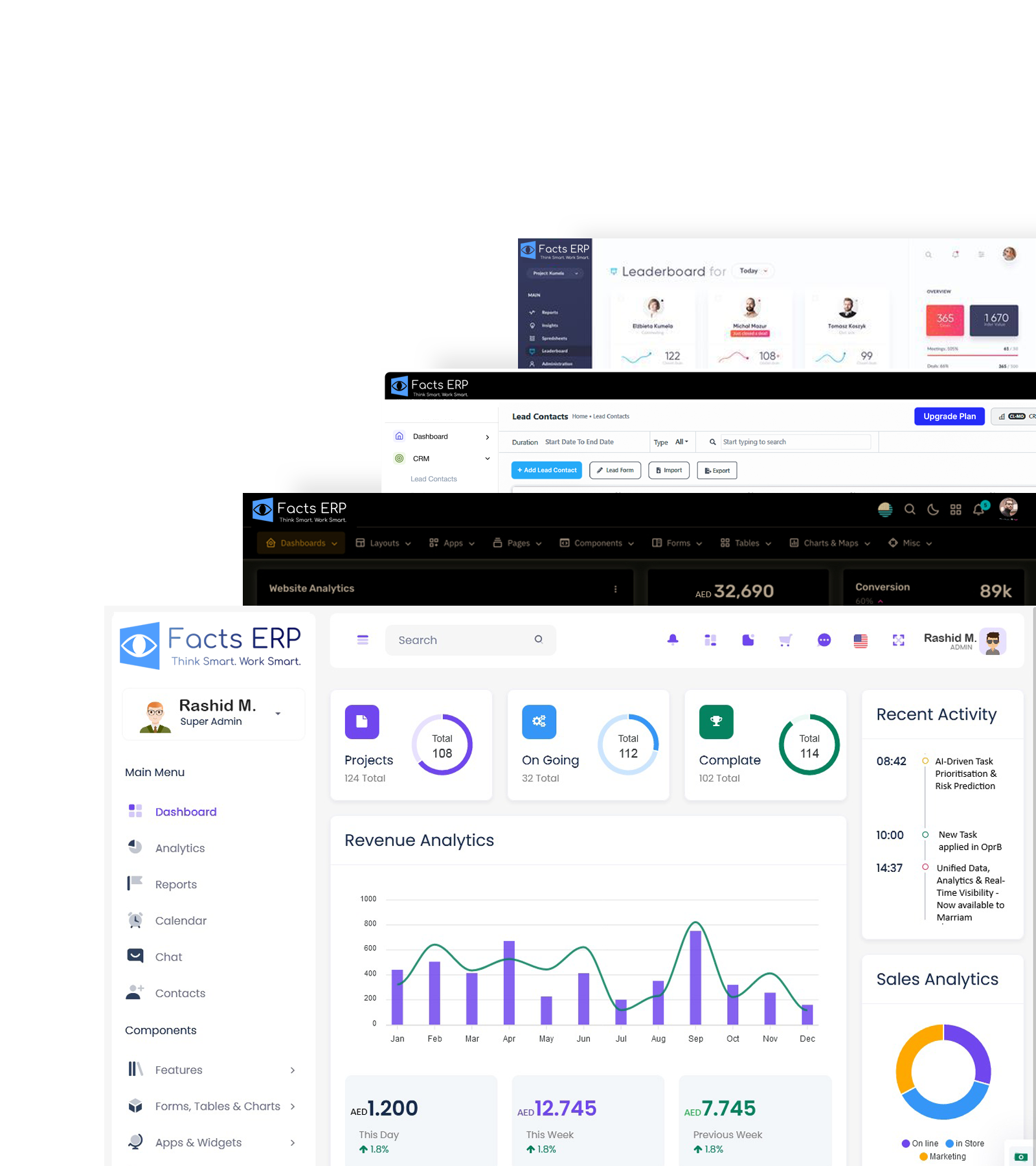
Your invoicing system creates the data that your provider validates and sends. That makes it the first thing to check. FACTS ERP’s e-invoicing page describes VAT-aligned invoice and credit note generation, an invoice store with audit trail, and API integrations with ERP, POS, accounting and CRM systems. The related VAT accounting software page covers VAT returns and reporting.
If you are running on spreadsheets or basic accounting software, e-invoicing may be a good moment to ask whether your system will still fit your business in 2027. Whatever you use, ask your vendor how its invoice data maps to the MoF mandatory fields and how rejected invoices are returned and corrected.
Frequently asked questions
When must small businesses comply with UAE e-invoicing?
Businesses with revenue below AED 50 million must appoint an ASP by 31 March 2027, and e-invoicing becomes mandatory on 1 July 2027.
Do I need to comply if I am not VAT-registered?
Yes, unless a specific exclusion applies. MoF states that e-invoicing applies to any person conducting business in the UAE regardless of VAT registration status. You would need a TIN. If you are registered with the FTA for any tax type, it is the first 10 digits of your TRN; if not, you generate one through EmaraTax.
What if I only sell to consumers?
A person engaged exclusively in business-to-consumer sales is not currently subject to the system. B2B transactions are in scope, so if you sell to both, prepare for the B2B side.
Do I need to replace my accounting software?
Not necessarily. What matters is whether your software can capture the mandatory fields and connect to an accredited provider. Ask your vendor, and test with real invoices before you commit.
Can I start before 1 July 2027?
Yes. Voluntary adoption has been open since 1 July 2026, and the penalty decision does not apply to voluntary users.
How long does preparation take?
It depends on your data and systems. We recommend working backwards from 31 March 2027 and treating end of February as your target for signing with a provider.
What happens if I miss the 31 March 2027 deadline?
Failing to appoint an ASP on time carries a penalty of AED 5,000 for each month or part of a month of delay under Cabinet Decision No. 106 of 2025.
Conclusion
Smaller businesses get more time, but the work is the same: confirm your scope, get your identifiers right, clean your data, appoint a verified provider and test with real invoices. Starting this month turns a deadline scramble into a routine project, and it lets you learn from the first wave.
Want help checking your invoicing data against the mandatory fields?
Talk to the FACTS ERP team or explore the FACTS ERP e-invoicing solution. Regulations can change, so confirm dates and requirements on the MoF portal before acting.
Sources
- UAE Ministry of Finance: eInvoicing portal
- Ministerial Decision No. 243 of 2025 on the Electronic Invoicing System
- Ministerial Decision No. 244 of 2025 on the Implementation of the Electronic Invoicing System
- UAE Ministry of Finance: Electronic Invoice Mandatory Fields, V1.0 (23 Feb 2026)
- UAE Ministry of Finance: Accredited Service Providers register
- UAE Ministry of Finance: Considerations for Selecting an Accredited Service Provider
- Cabinet Decision No. 106 of 2025 on Violations and Administrative Penalties
- Baker McKenzie: summary of MoF’s Electronic Invoicing Guidelines (Feb 2026)
- KPMG: UAE technical guidance on mandatory e-invoicing fields (Feb 2026)
This article is general information, not legal or tax advice. The checklist timing is a recommendation; the only regulatory dates are 31 March 2027 and 1 July 2027.
Explore FACTS ERP
Hospitality / Industries / IT Consulting Advisory / limousine booking software / Logistics ERP Software