Why Every Dubai Business Needs an ERP System in 2025
Published by FactsERP · 12 min read
Dubai is moving faster than almost any city on earth. With over 350,000 active businesses in the emirate and the government’s push toward a fully digital economy by 2031, companies that still run on spreadsheets and disconnected software risk being left behind. Enterprise Resource Planning (ERP) has become the backbone of Dubai’s most competitive businesses.
Whether you run a trading company in Jebel Ali, a restaurant chain across Downtown Dubai, or a construction firm in Business Bay, an ERP system connects every part of your operation — finance, inventory, HR, sales, procurement — into a single, intelligent platform. This guide breaks down exactly what ERP means for Dubai businesses, why it matters now more than ever, and what real companies have achieved after implementation.
What Is ERP and Why Does Dubai Demand It?
Enterprise Resource Planning (ERP) is software that integrates all core business processes into one unified system. Instead of your accounts team using one tool, your warehouse team using another, and your sales team working from a spreadsheet, an ERP brings everything into a single source of truth.
Dubai’s business environment creates specific pressures that make ERP not just useful but essential:
- VAT compliance (5%): Introduced in January 2018, UAE VAT requires precise transaction records, tax invoices, and quarterly returns. Manual processes are a compliance time bomb.
- Multi-currency operations: Dubai businesses routinely deal in AED, USD, EUR, GBP, and INR simultaneously — ERP systems handle real-time exchange rates automatically.
- Free zone regulations: JAFZA, DMCC, DIFC, and other free zones each carry their own compliance requirements. ERP makes audit trails effortless.
- Rapid growth: Dubai’s economy grew 3.2% in 2024. Companies scaling fast cannot afford operational bottlenecks caused by disconnected systems.
- WPS (Wage Protection System): The UAE Ministry of Human Resources mandates salary payments through WPS. ERP systems with integrated payroll automate this compliance.
Key Sectors Using ERP in Dubai
1. Trading and Distribution
Dubai is the Gulf’s trading hub. A typical mid-size trading company in Deira handles thousands of SKUs, multiple suppliers from China, India, and Europe, and customers across the GCC. Without an ERP, procurement managers are constantly firefighting — running out of stock on fast-moving items, over-ordering slow ones, and losing track of landed costs. ERP systems like FactsERP bring purchase orders, warehouse management, sales orders, and financials into one screen.
2. Construction and Real Estate
Dubai’s skyline is never static. Construction firms manage complex project budgets, subcontractor payments, equipment costs, and material procurement simultaneously. ERP systems provide project-based costing, progress billing, and subcontractor management — critical for staying profitable across multi-year projects in areas like Dubai South and Emaar’s mega-developments.
3. Retail and F&B
Dubai’s retail sector is world-class, and competition is fierce. Mall operators demand data. Franchise owners running 20+ outlets need real-time visibility into daily sales, wastage, and staff costs. ERP ties point-of-sale data to inventory and finance automatically, giving owners the information they need — not three weeks later, but tonight.
4. Manufacturing
Dubai Industrial City hosts hundreds of manufacturers. Whether producing food products, building materials, or consumer goods for GCC distribution, manufacturers need production planning, bill of materials management, and quality control — all core ERP functions.
A Trading Company in Jebel Ali Cuts Stock Losses by 35%
A Dubai-based FMCG trading company managing 4,500 SKUs across two warehouses had no real-time visibility into stock levels. Buyers were placing duplicate orders because they couldn’t see what was already in transit. After implementing a cloud ERP system, the company integrated their purchasing, warehousing, and accounts into one platform. Within six months, they reduced excess stock holding by 35%, cut monthly stock-taking from four days to six hours, and eliminated the duplicate ordering problem entirely. Their finance team filed their first VAT return in under two hours — previously it took two weeks.
ERP and VAT Compliance in Dubai
When the UAE introduced VAT at 5% in January 2018, it was a tectonic shift for businesses that had never dealt with consumption tax. The Federal Tax Authority (FTA) requires businesses to maintain detailed transaction records for five years, issue compliant tax invoices, and file accurate quarterly or monthly VAT returns.
An ERP system purpose-built for the UAE automatically applies the correct VAT treatment to each transaction — standard rate (5%), zero-rated, or exempt — and generates FTA-compliant tax invoices with all required fields. When return time comes, the VAT report is already compiled. No scrambling. No manual reconciliation. No penalties.
FactsERP’s VAT module is designed specifically for UAE regulations, ensuring your business stays FTA-compliant as rules evolve.
Cloud ERP vs. On-Premise ERP: What Dubai Businesses Are Choosing
Five years ago, many Dubai businesses insisted on on-premise ERP — servers in their own office. Today, the trend has reversed sharply. Cloud ERP now dominates for three reasons: Dubai’s excellent broadband infrastructure makes cloud reliable, subscription pricing eliminates large upfront costs, and remote access suits Dubai’s mobile, multi-site business culture.
A business owner in their villa in Jumeirah can approve purchase orders, check yesterday’s cash position, and review payroll — all from a phone. That visibility used to be reserved for enterprises with million-dirham IT budgets. Cloud ERP democratises it.
Dubai’s Digital Economy Agenda
The Dubai Economic Agenda (D33) targets doubling Dubai’s GDP by 2033. The government is actively incentivising digital transformation. Businesses that invest in ERP and digital infrastructure today are aligning with — not just surviving — this wave. Free zone authorities including DMCC and Dubai Internet City have both launched initiatives to support SME digitalisation.
How to Choose the Right ERP for Your Dubai Business
The ERP market is crowded. SAP, Oracle, Microsoft Dynamics, and dozens of regional and local providers compete for Dubai business. Here is what to prioritise:
- UAE localisation: WPS payroll, FTA VAT compliance, Arabic language support, and multi-currency in AED are non-negotiable. Generic global ERP systems often require expensive customisation to meet these.
- Industry fit: A trading ERP and a manufacturing ERP solve different problems. Choose a solution built for your sector.
- Implementation support: Dubai’s market is unique. A vendor with local implementation consultants who understand UAE business practices is worth far more than the cheapest global software.
- Scalability: If you plan to open in Abu Dhabi, Riyadh, or beyond, your ERP needs to grow with you.
- Total cost of ownership: Compare subscription costs, implementation fees, training, and support — not just the licence price.
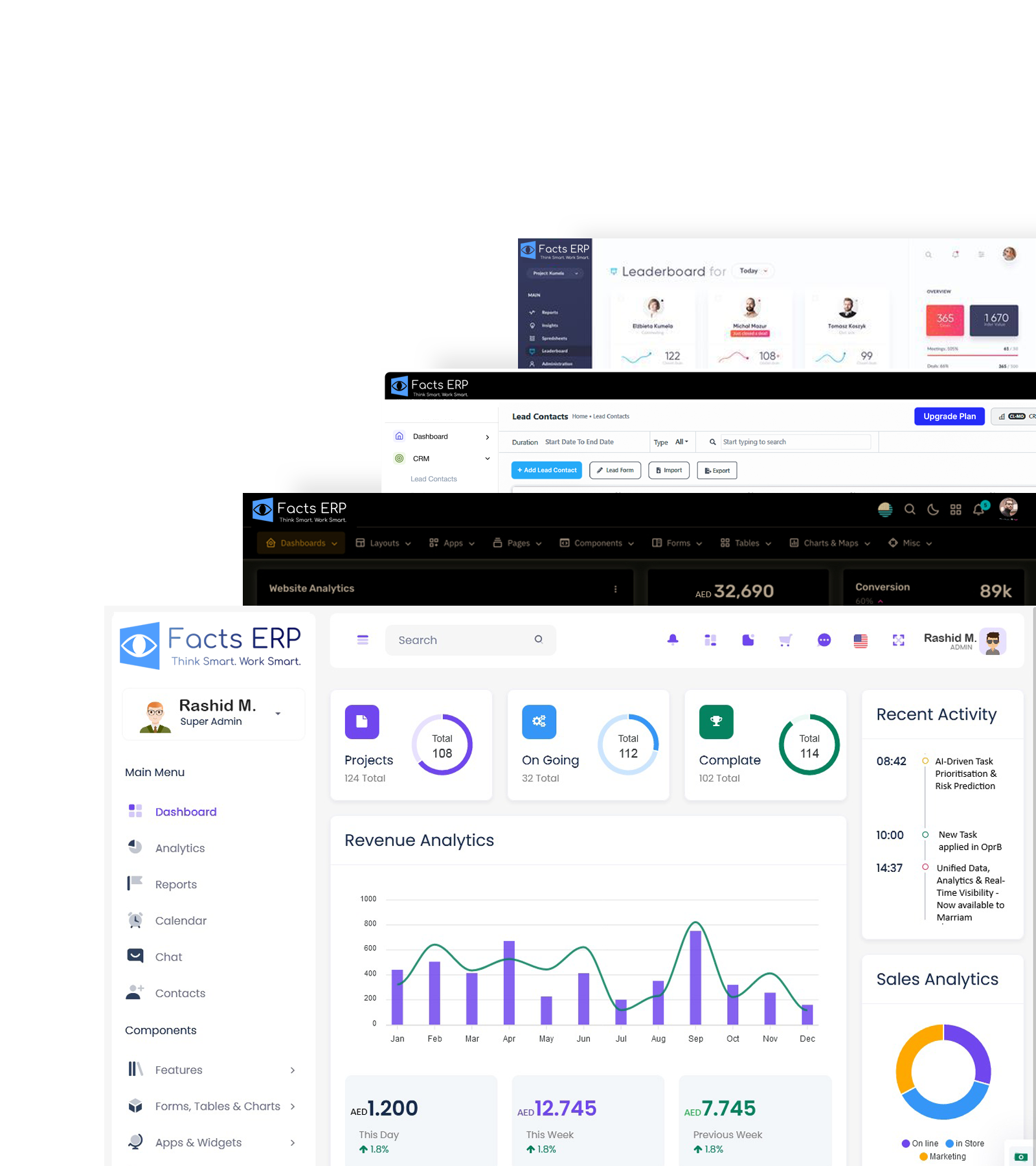
FactsERP was built specifically for GCC businesses, with deep UAE localisation, Arabic-English bilingual interface, and a local implementation team based in the UAE. Explore our full suite of ERP solutions for Dubai businesses or contact our team for a free consultation.
The ROI of ERP in Dubai: Real Numbers
ERP is an investment, and Dubai business owners rightly want to see returns. Based on implementations across the UAE market, businesses typically see:
- 25–40% reduction in time spent on month-end close — finance teams stop chasing data and start analysing it.
- 20–30% improvement in inventory accuracy — knowing what you have, where it is, and what it costs.
- 15–25% reduction in procurement costs — better visibility means better negotiation and fewer emergency orders.
- Near-elimination of VAT penalty risk — automated compliance removes human error from tax filings.
- Significant reduction in audit preparation time — complete digital trail means audits that used to take weeks now take days.
Getting Started: ERP Implementation in Dubai
Successful ERP implementation is as much about change management as technology. The businesses that get the most from their ERP do four things well:
- Define clear goals before selecting software — know which pain points you are solving.
- Appoint an internal project champion — ERP succeeds when someone inside the business owns it.
- Invest in training — software is only as good as the people using it.
- Start with core modules, then expand — finance, inventory, and procurement first; add manufacturing or project management as you grow.
Ready to see how ERP transforms Dubai businesses? Book a free demo with FactsERP — our consultants will map the right solution to your business, not the other way around.
Transform Your Dubai Business with FactsERP
UAE-localised ERP built for trading, manufacturing, construction, and more. VAT compliant, WPS ready, Arabic-English bilingual.
Get a Free Consultation →